Baseball Case Guide: How to Display and Protect Signed Baseballs
A signed baseball can lose its autograph to sunlight and handling. Here is how to choose the right baseball case, the materials that protect best and how to display a collection.

In this article
A baseball case protects a ball from dust, moisture, fingerprints and sunlight while showing it off on a shelf or desk. For autographed balls, home run balls and game-used keepsakes, a good case is the difference between a souvenir that lasts a lifetime and a signature that fades away in a few years. This guide explains the types of baseball cases, what to look for and how to care for a collection.
Why a baseball needs a case
- Sunlight – ultraviolet (UV) light is the biggest enemy of autographs. It fades ink and yellows the leather.
- Handling – skin oils and friction smudge signatures and darken the ball.
- Dust and moisture – they discolor leather and can damage the stitching over time.
- Accidents – a ball on an open shelf can roll off, get scuffed or be used for a game of catch by someone who does not know its value.
Types of baseball cases
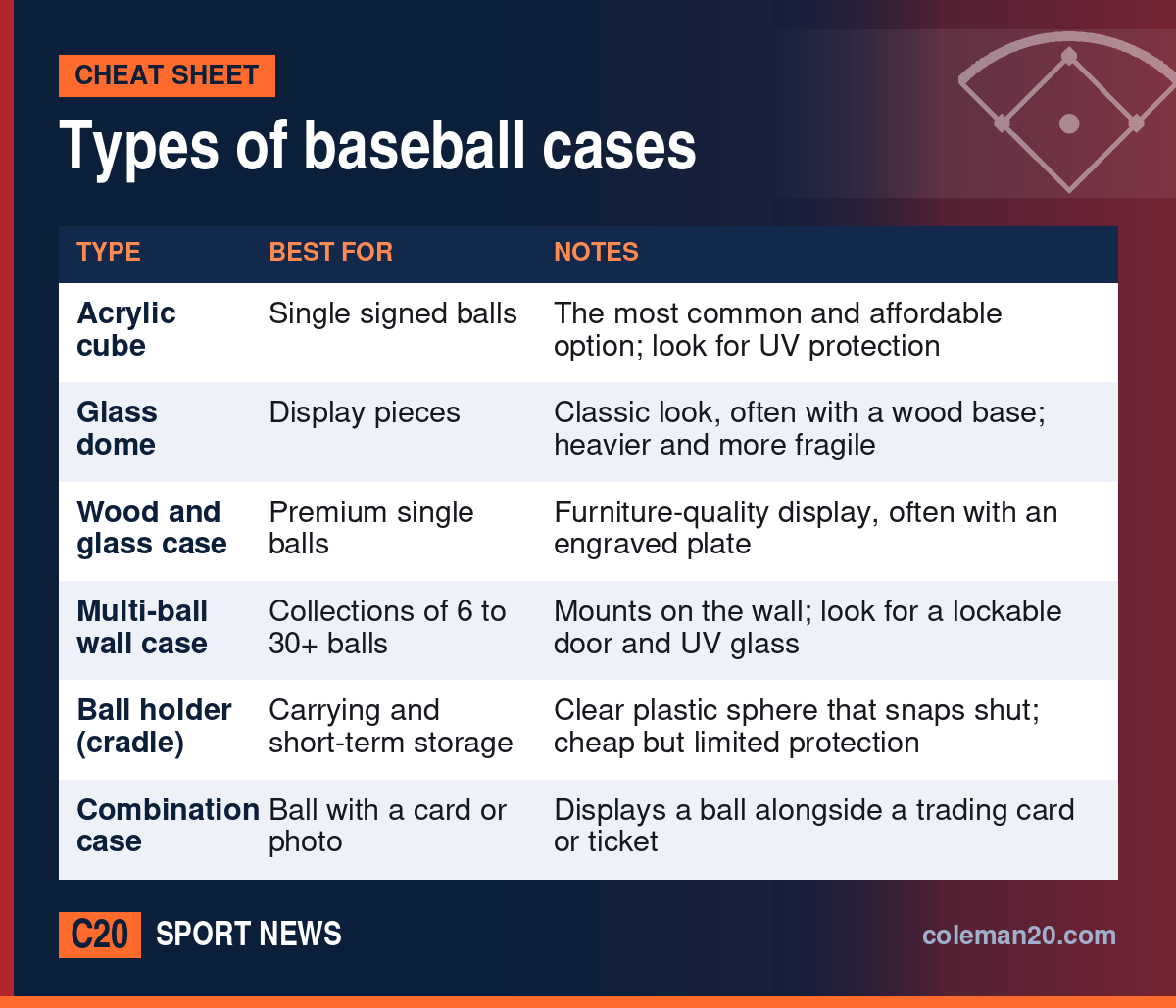
| Type | Best for | Notes |
|---|---|---|
| Acrylic cube | Single signed balls | The most common and affordable option; look for UV protection |
| Glass dome | Display pieces | Classic look, often with a wood base; heavier and more fragile |
| Wood and glass case | Premium single balls | Furniture-quality display, often with an engraved plate |
| Multi-ball wall case | Collections of 6 to 30+ balls | Mounts on the wall; look for a lockable door and UV glass |
| Ball holder (cradle) | Carrying and short-term storage | Clear plastic sphere that snaps shut; cheap but limited protection |
| Combination case | Ball with a card or photo | Displays a ball alongside a trading card or ticket |
What to look for
UV protection
This is the most important feature for autographs. Many cases are marketed as blocking a high percentage of UV light. Even with a UV-protected case, avoid displaying the ball in direct sunlight.
Material
Acrylic is light, shatter-resistant and clear, which makes it the most popular choice. Glass resists scratches better but can break. Cheap plastics can turn yellow and cloudy over time.
Size and fit
An official baseball is about 9 to 9.25 inches in circumference, roughly 2.9 inches in diameter. A standard cube fits it with a small stand inside. Softballs need larger cases.
A stable base
A ball should sit on a holder or cradle so it does not roll around inside the case. Some cases have a base designed to display the "sweet spot," the narrowest space between the seams, where the most valuable signatures usually appear.
Room for details
A nameplate or engraved base can record the player, date and occasion, such as "First home run" or "Signed at spring training."
How to display a signed baseball
- Wash and dry your hands, or wear cotton gloves, before handling the ball.
- Hold the ball by the seams, away from the signature.
- Place it on the stand with the signature facing forward and level.
- Close the case and wipe off fingerprints with a microfiber cloth.
- Choose a shelf away from windows, heat sources and humidity, such as a bathroom or basement.
Mistakes that ruin autographed baseballs
- Displaying the ball in a sunny room, even inside a case without UV protection.
- Storing the ball in an attic or garage where temperature and humidity swing.
- Cleaning the ball with water, solvents or erasers.
- Letting people pass the ball around at parties.
- Using cheap cases that yellow and trap moisture.
- Getting the ball signed with the wrong pen: ballpoint pens in blue ink are often recommended for baseballs, since markers can bleed into the leather.
Displaying a collection
Collectors with many balls often use wall-mounted cases with individual compartments. Popular themes include signed balls from a single team, Hall of Famers, every player from a championship roster, or balls from stadiums visited on a road trip. Group balls by theme, add labels, and keep the case away from bright light. Some collectors rotate the balls they display and keep others in storage to limit light exposure.
Storing balls you are not displaying
For long-term storage, place each ball in a cube, then keep the cubes in a closed box in a cool, dry, dark room. A stable indoor temperature and moderate humidity are best. Avoid plastic bags, which can trap moisture against the leather.
Authenticity and value
If a ball may be valuable, keep any certificate of authenticity together with it. Professional authentication services can verify signatures and sometimes seal a ball with a tamper-evident hologram. A clean, unfaded ball in a quality case is worth more to collectors than the same ball with a faded signature.
Love baseball history? Read our list of cool baseball facts and the story of baseball in the Dominican Republic.
Frequently asked questions
What is the best case for a signed baseball?
A UV-protected acrylic cube with a stand is the most popular option. Glass or wood-and-glass cases suit premium displays.
Do baseball cases prevent fading?
UV-protected cases slow fading, but the ball should still be kept out of direct sunlight.
What size case does a baseball need?
A standard baseball is about 2.9 inches in diameter, and most baseball cubes are made to fit it with a small stand.
How should I store autographed baseballs long term?
In individual cases inside a closed box, in a cool, dry, dark room with stable temperature and humidity.
Keep reading


Editors' picks
- What Sport Season Is It Right Now? A Month-by-Month Guide to US SportsSports Facts
- The Hardest Sports in the World, Ranked by What They DemandSports Facts
- What Is the Most Watched Sport in the World? Global and US RankingsSports Facts
- 30 Cool Baseball Facts Most Fans Don't KnowBaseball
- The Most Famous Sporting Events in the WorldSports Facts