Sports Graphic Design: Logos, Jerseys, Game-Day Graphics and Careers
Behind every great team brand is a designer. Here is what sports graphic designers do, the tools they use, the stories behind famous logos and how to start a career in sports design.

In this article
Sports graphic design is the visual side of the sports world. It includes team logos, uniforms, social media graphics, broadcast graphics, posters, merchandise and stadium signage. A strong design identity helps teams sell tickets and jerseys, gives fans something to rally around and makes a brand instantly recognizable. Today, with teams posting dozens of graphics every game day, sports design is one of the busiest areas of the design industry.
What sports graphic designers create
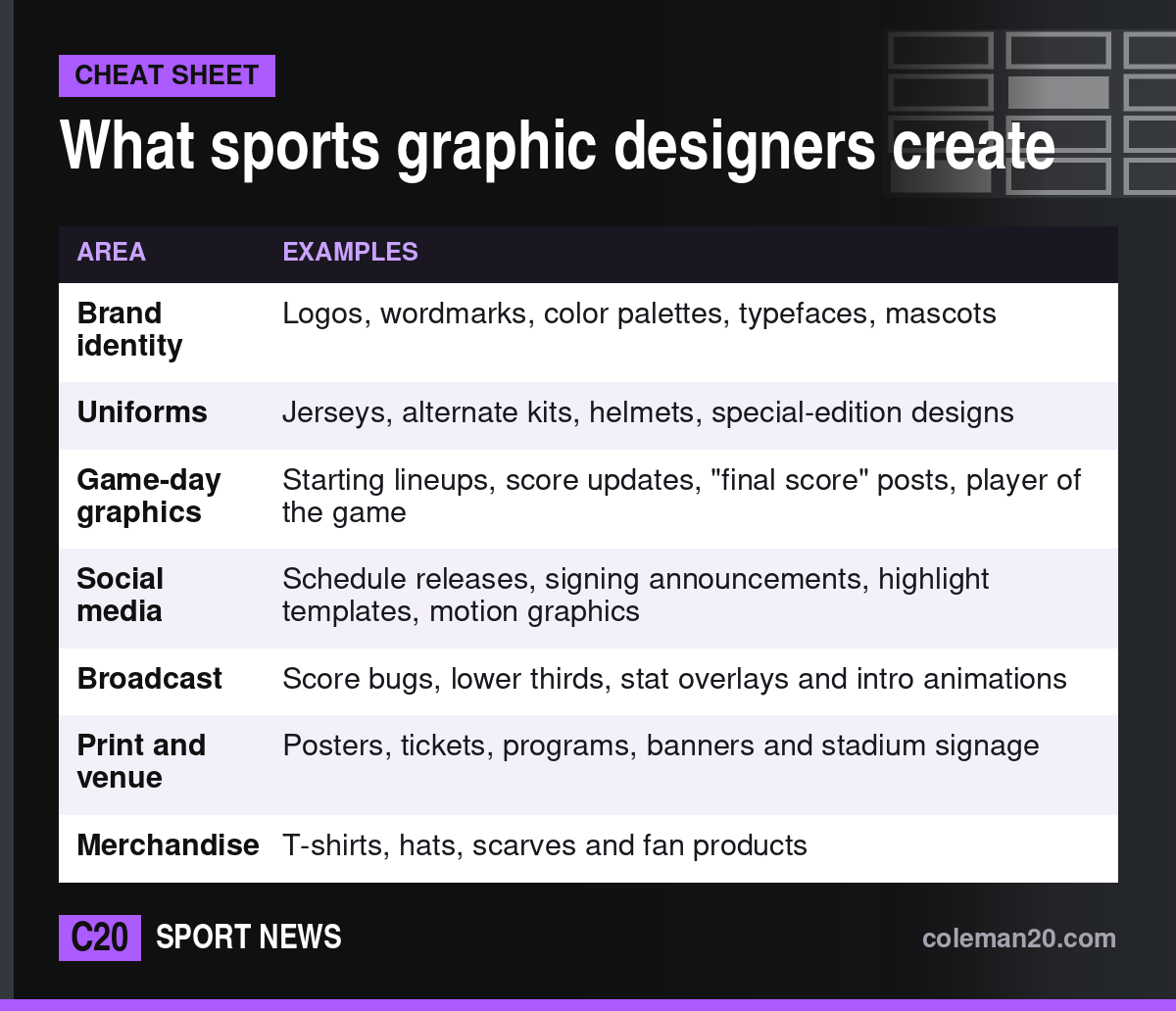
| Area | Examples |
|---|---|
| Brand identity | Logos, wordmarks, color palettes, typefaces, mascots |
| Uniforms | Jerseys, alternate kits, helmets, special-edition designs |
| Game-day graphics | Starting lineups, score updates, "final score" posts, player of the game |
| Social media | Schedule releases, signing announcements, highlight templates, motion graphics |
| Broadcast | Score bugs, lower thirds, stat overlays and intro animations |
| Print and venue | Posters, tickets, programs, banners and stadium signage |
| Merchandise | T-shirts, hats, scarves and fan products |
Famous logo stories
The Nike Swoosh
The Swoosh was designed in 1971 by Carolyn Davidson, then a graphic design student at Portland State University, who was paid $35. Nike co-founder Phil Knight later gave her company shares in recognition of the logo's success.
The NBA logo
The NBA's red, white and blue logo was created in 1969 by designer Alan Siegel. The silhouette is widely believed to be based on a photo of Hall of Famer Jerry West, although the league has never officially confirmed it.
The New York Yankees "NY"
The interlocking "NY" is one of the most recognizable sports marks in the world. Its design is often traced to a medal made by Tiffany & Co. in the 19th century for a New York police officer, and it has become a fashion symbol far beyond baseball.
Principles of great sports design
- Simplicity – great logos work at any size, from a stadium banner to a phone screen.
- Identity – the design should reflect the team's city, history and character.
- Color – team colors must be distinctive and look good on uniforms, screens and merchandise.
- Typography – custom number and letter styles give jerseys and graphics a unique look.
- Consistency – a brand guide keeps every post, poster and product on brand.
- Energy – sports graphics should feel dynamic, using bold angles, motion and photography.
Tools sports designers use
| Tool | Used for |
|---|---|
| Adobe Photoshop | Photo editing and game-day graphics |
| Adobe Illustrator | Logos, vector artwork, uniforms |
| Adobe After Effects | Motion graphics and animated posts |
| Cinema 4D or Blender | 3D graphics and renders |
| Figma | Templates, layouts and collaboration |
| Canva | Quick graphics for smaller teams and clubs |
Trends in sports design
- Motion first – animated graphics and short videos perform better on social media than static images.
- Retro and throwback – teams bring back classic logos and uniforms, often as alternate jerseys that sell well.
- City editions – special uniforms celebrate local culture and neighborhoods.
- Clean, flat logos – many teams have simplified their logos to work better on digital screens.
- 3D and AI tools – 3D renders and new software speed up production for busy social media teams.
How to start a career in sports graphic design
- Learn the fundamentals – typography, color theory, layout and branding, through a degree, courses or self-study.
- Master the tools – Photoshop, Illustrator and After Effects are the industry standards.
- Build a sports portfolio – create concept rebrands, game-day graphics and jersey concepts for real or fictional teams.
- Post your work – share it on design platforms and social media, where many sports designers have been discovered.
- Start local – offer design work to high school, college or minor league teams to build real experience.
- Apply widely – teams, leagues, colleges, sports agencies, broadcasters and apparel brands all hire designers.
Many jobs are on social media teams, which need designers who can work fast during live games. Working hours often follow the sports calendar, including nights and weekends.
Respect copyright and trademarks
Team logos and names are protected trademarks. Concept work in a portfolio is generally accepted in the design community, but selling merchandise with official logos without a license is not allowed. If you design for a team, make sure you have permission to use its marks.
For more about the business behind team brands, read how big the sports industry is and the biggest sports trends.
Frequently asked questions
What is sports graphic design?
The design of visual materials for sports: logos, uniforms, social media and broadcast graphics, posters and merchandise.
Who designed the Nike Swoosh?
Carolyn Davidson, a graphic design student at Portland State University, in 1971.
What software do sports designers use?
Mainly Adobe Photoshop, Illustrator and After Effects, along with 3D tools such as Cinema 4D or Blender.
How do I become a sports graphic designer?
Learn design fundamentals and tools, build a sports-focused portfolio, share your work online and start with local teams.
Keep reading

Editors' picks
- What Sport Season Is It Right Now? A Month-by-Month Guide to US SportsSports Facts
- The Hardest Sports in the World, Ranked by What They DemandSports Facts
- What Is the Most Watched Sport in the World? Global and US RankingsSports Facts
- 30 Cool Baseball Facts Most Fans Don't KnowBaseball
- The Most Famous Sporting Events in the WorldSports Facts