The Striker in Soccer: Role, Types and Famous Examples
The striker has the simplest job description in soccer and one of the hardest to do: score. Here is what strikers do, the main types and the players who defined the position.

In this article
The striker is the player whose main job is to score goals. Usually positioned closest to the opponent's goal, the striker leads the attack and finishes the chances teammates create. Strikers are often the most famous and highest-paid players on a team, because goals win games.
But "striker" covers several very different styles of player, and modern strikers are expected to do far more than wait for the ball in front of goal.
What a striker does
- Score goals – with both feet, the head and from any angle.
- Make runs – timing movements behind defenders or into space to receive passes.
- Hold up the ball – keeping possession with their back to goal so teammates can join the attack.
- Link play – dropping deeper to combine with midfielders and wingers.
- Press – chasing defenders and goalkeepers to win the ball back high up the field.
Striker vs forward vs center forward
The terms overlap. "Forward" is the broad category of attacking players, including wingers. "Striker" and "center forward" usually mean the central attacker. Formation diagrams show the striker with the number 9 role, and "number 9" itself has become shorthand for a classic central striker.
Types of strikers
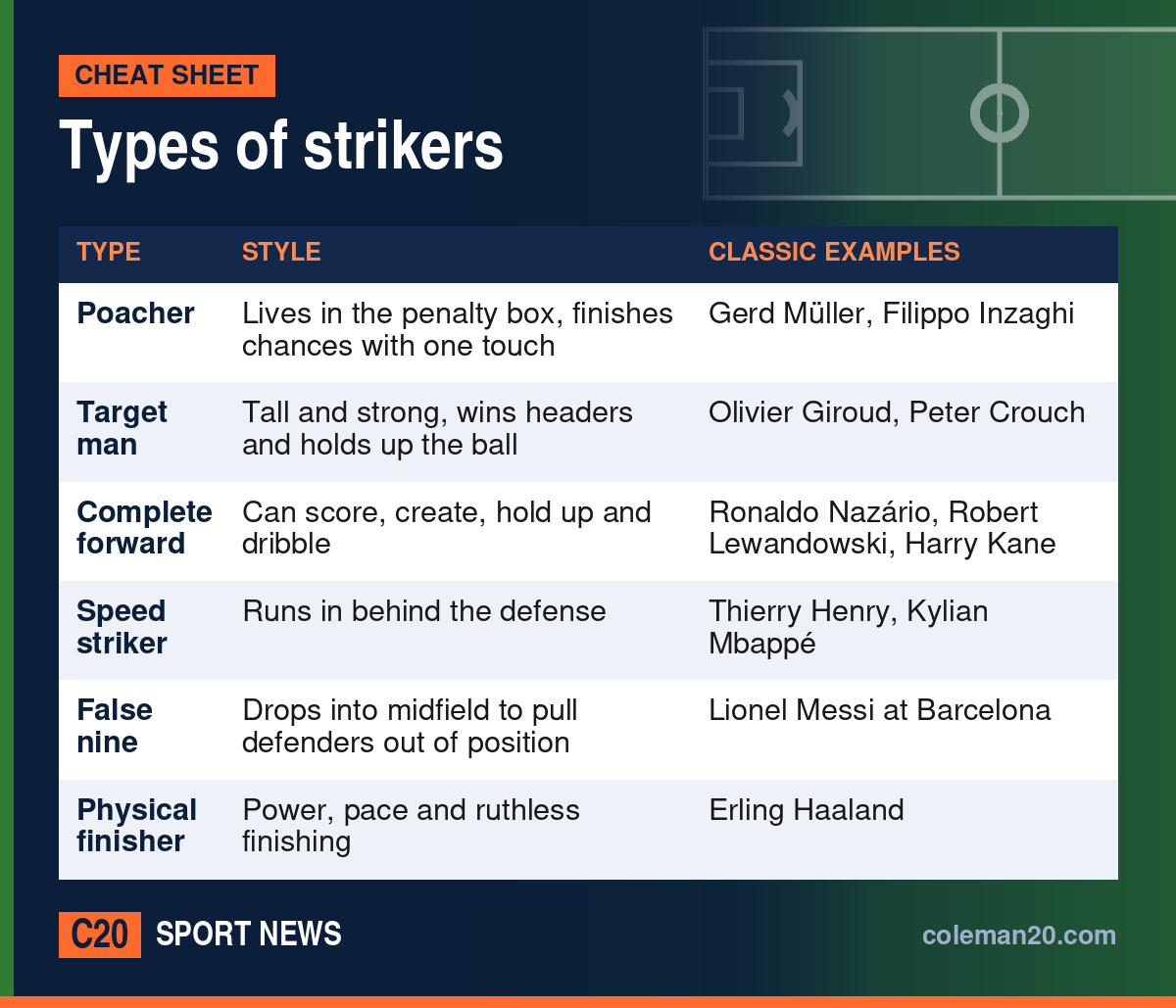
| Type | Style | Classic examples |
|---|---|---|
| Poacher | Lives in the penalty box, finishes chances with one touch | Gerd Müller, Filippo Inzaghi |
| Target man | Tall and strong, wins headers and holds up the ball | Olivier Giroud, Peter Crouch |
| Complete forward | Can score, create, hold up and dribble | Ronaldo Nazário, Robert Lewandowski, Harry Kane |
| Speed striker | Runs in behind the defense | Thierry Henry, Kylian Mbappé |
| False nine | Drops into midfield to pull defenders out of position | Lionel Messi at Barcelona |
| Physical finisher | Power, pace and ruthless finishing | Erling Haaland |
Key skills of a great striker
Finishing
The ability to convert chances calmly under pressure, often with just one or two touches. Great strikers pick their spot instead of simply shooting hard.
Movement
Many goals are decided before the striker touches the ball, by a run that loses a defender. Elite strikers are constantly moving, checking their shoulder and timing runs to stay onside.
Heading
A large share of goals come from crosses and set pieces, so heading technique and timing in the air are essential.
Composure and confidence
Strikers miss far more chances than they score. The best ones forget a miss immediately and stay ready for the next opportunity.
The greatest strikers in history
- Pelé – the Brazilian legend and three-time World Cup winner, one of the most prolific goalscorers ever.
- Gerd Müller – Germany's "Der Bomber," famous for scoring from anywhere inside the box.
- Ronaldo Nazário – a two-time World Cup winner whose speed and dribbling redefined the position in the 1990s.
- Cristiano Ronaldo – the all-time leading scorer in men's international football.
- Lionel Messi – usually a winger or playmaker, but his false-nine role changed how teams use the position.
- Christine Sinclair – Canada's captain, the all-time leading scorer in international soccer, men or women.
American strikers
The United States has produced several great forwards. Landon Donovan and Clint Dempsey share the US men's national team scoring record. On the women's side, Abby Wambach and Alex Morgan became household names, with Wambach scoring well over 150 international goals. The US women's team's success has made the striker one of the most recognized positions in American soccer.
How the striker role has changed
In the early days of soccer, teams used formations with five or more forwards. As tactics developed, the number of attackers fell, and by the 1990s many teams played with two strikers in a 4-4-2. Today most top teams use a single central striker in a 4-3-3 or 4-2-3-1, supported by wingers and attacking midfielders.
The modern striker is expected to do more than score. Pressing from the front became essential as coaches built teams around winning the ball back high up the field. Strikers also need to link with midfielders and create space for teammates. That is why players like Harry Kane, who can score and also make assists, are so valuable.
Statistics have also changed how strikers are judged. Analysts use "expected goals" (xG) to measure the quality of chances a player gets. A striker who regularly gets into high-xG positions is doing their job well, even during a short scoring drought.
How to become a better striker
- Practice finishing with both feet from different angles every session.
- Work on first touch, so you can control and shoot quickly.
- Study the runs of top strikers on video and copy their timing.
- Train heading technique safely, with proper supervision for young players.
- Build speed and agility for short, sharp movements.
For more on why soccer captures so many fans, read is soccer the best sport in the world.
Frequently asked questions
What does a striker do in soccer?
A striker is the main goalscorer. They lead the attack, make runs behind defenders, hold up the ball and finish chances.
What is the difference between a striker and a forward?
Forward is the broader term for attacking players, including wingers. Striker usually refers to the central attacker whose main job is scoring.
What number does a striker wear?
Traditionally number 9, which is why a classic central striker is often called a "number 9."
What is a false nine?
A striker who drops back into midfield instead of staying high, pulling defenders out of position to create space for teammates.
Keep reading


Editors' picks
- What Sport Season Is It Right Now? A Month-by-Month Guide to US SportsSports Facts
- The Hardest Sports in the World, Ranked by What They DemandSports Facts
- What Is the Most Watched Sport in the World? Global and US RankingsSports Facts
- 30 Cool Baseball Facts Most Fans Don't KnowBaseball
- The Most Famous Sporting Events in the WorldSports Facts