Tennis Scoring Explained: Points, Games, Sets and Tiebreaks
Love, 15, 30, 40, deuce, ad-in: tennis scoring sounds strange until you see how it works. Here is the whole system, from a single point to a Grand Slam final set.

In this article
Tennis scoring has three layers: points make games, games make sets, and sets make a match. The unusual names for points are what confuses newcomers. Once you know them, the rest is simple.
Points within a game
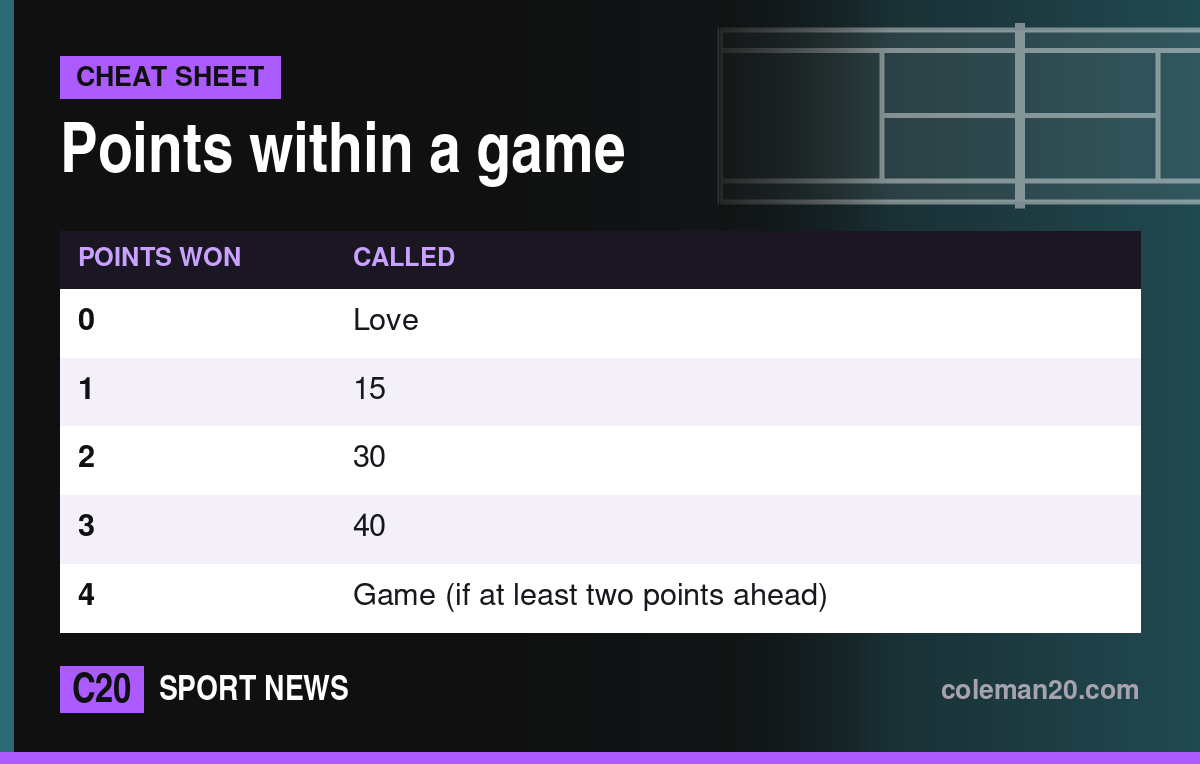
| Points won | Called |
|---|---|
| 0 | Love |
| 1 | 15 |
| 2 | 30 |
| 3 | 40 |
| 4 | Game (if at least two points ahead) |
The server's score is said first: "30–15" means the server has two points and the receiver one.
Deuce and advantage
At 40–40 the score is deuce. A player must then win two points in a row to take the game. Winning the next point gives advantage ("ad"): "ad-in" or "advantage server" if the server won it, "ad-out" if the receiver did. Win the following point and you win the game; lose it and the score goes back to deuce.
Games and sets
- A set is won by the first player to win six games, with a margin of at least two (6–4, 7–5).
- At 6–6, most sets are decided by a tiebreak.
- Players change ends after odd-numbered games.
The tiebreak
In a standard tiebreak, points are counted normally (1, 2, 3...). The first player to 7 points with a two-point lead wins the set 7–6. Serve alternates every two points after the first, and players change ends every six points.
Since 2022, all four Grand Slams play a 10-point tiebreak at 6–6 in the final set: first to 10, by two.
Matches
- Most matches are best of three sets.
- Men's singles at the Grand Slams are best of five.
- In many doubles events, a match tiebreak (first to 10) replaces the third set.
No-ad scoring
Used in college tennis and many doubles and recreational formats: at deuce, a single deciding point wins the game, which keeps matches shorter.
Why 15, 30, 40?
No one knows for certain. A popular theory says medieval scorers used a clock face, moving the hand to 15, 30 and 45, and 45 was later shortened to 40. "Love" for zero may come from the idea of playing for love rather than for stakes, or, according to another theory, from the French "l'œuf", egg, for its zero shape. Neither is proven.
Table tennis is different
Table tennis counts points simply: games are played to 11, by two, and matches are usually best of five or seven games.
Frequently asked questions
What does ad mean in tennis scoring?
Advantage: the player who wins the point after deuce has the advantage and wins the game with the next point.
Why is tennis scored 15, 30, 40?
The origin is uncertain. A common theory links it to a clock face, with 45 shortened to 40.
How many games are in a set of tennis?
A set goes to six games with a two-game lead, or a tiebreak at 6–6.
What is deuce in tennis?
A score of 40–40. A player must win two consecutive points from deuce to win the game.
Sources
Keep reading



Editors' picks
- What Sport Season Is It Right Now? A Month-by-Month Guide to US SportsSports Facts
- The Hardest Sports in the World, Ranked by What They DemandSports Facts
- What Is the Most Watched Sport in the World? Global and US RankingsSports Facts
- 30 Cool Baseball Facts Most Fans Don't KnowBaseball
- The Most Famous Sporting Events in the WorldSports Facts