Volleyball Positions Explained: Setter, Hitters, Middle Blocker and Libero
Six players, six rotations and a jersey that looks different from the rest. Here is what each volleyball position does and how teams line up.

In this article
Indoor volleyball has six players per side, and every one of them rotates around the court during a set. That makes positions a little confusing at first: a player's place on the court changes all the time, but his or her job stays the same. Here is what each specialist does, how the rotation works and how teams organize their lineup.
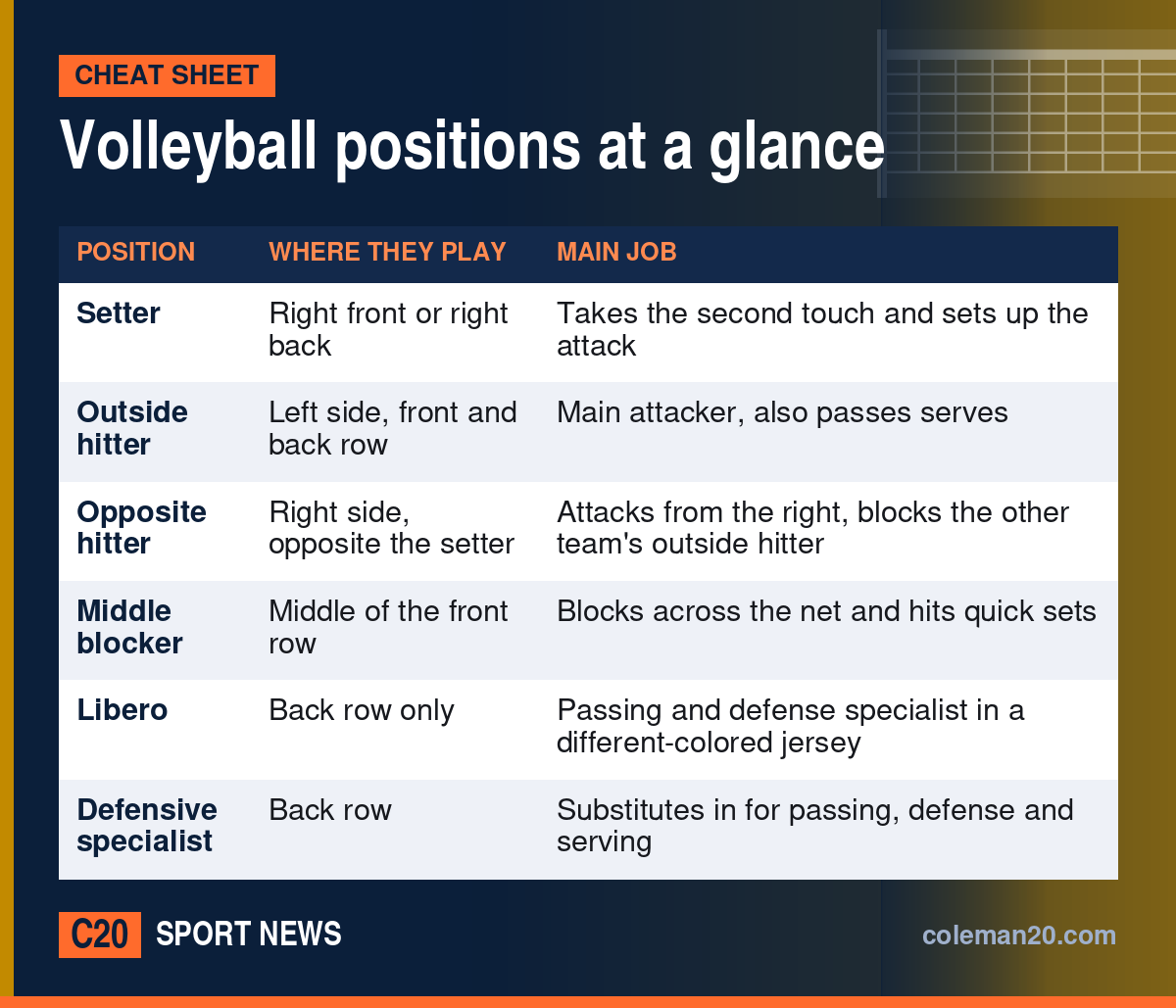
Volleyball positions at a glance
| Position | Where they play | Main job |
|---|---|---|
| Setter | Right front or right back | Takes the second touch and sets up the attack |
| Outside hitter | Left side, front and back row | Main attacker, also passes serves |
| Opposite hitter | Right side, opposite the setter | Attacks from the right, blocks the other team's outside hitter |
| Middle blocker | Middle of the front row | Blocks across the net and hits quick sets |
| Libero | Back row only | Passing and defense specialist in a different-colored jersey |
| Defensive specialist | Back row | Substitutes in for passing, defense and serving |
How rotation works
The court has six spots, numbered counterclockwise starting with the server in the right back corner: 1 is right back, 2 right front, 3 middle front, 4 left front, 5 left back and 6 middle back. When a team wins the right to serve from the other side, its players rotate one spot clockwise, and the player who moves into position 1 serves.
At the moment of the serve, players must be in the correct order relative to their neighbors. Once the ball is served, they can move anywhere. That is why you see players switch places right after the serve, sliding into their specialist positions. The only lasting limit is for back-row players, who cannot block or attack the ball above the height of the net from in front of the 3-meter attack line.
Setter
The setter is the quarterback of a volleyball team. The setter takes the second touch on almost every play and decides who gets the ball. A good setter delivers consistent, hittable sets, reads the opposing blockers and keeps them guessing. Setters usually release to the right front area after the serve, because setting from there gives the hitters the best angles.
Setters need soft hands, quick feet and good decision making. They also block when they are in the front row and can attack the second ball themselves, a surprise play called a setter dump.
Outside hitter
The outside hitter, also called the left-side hitter, is typically the team's main attacker and receives the most sets, especially when the pass is not perfect and the setter needs a reliable option. Outside hitters also play all the way around the rotation in many lineups, so they must pass serves and play defense in the back row. This all-round load makes outside hitter one of the most demanding positions.
Opposite hitter
The opposite hitter lines up across from the setter in the rotation and attacks from the right side of the court. Opposites are often the biggest scorers at higher levels: they can attack from the front row and from behind the attack line in the back row. On defense, the opposite blocks the other team's outside hitter. Because the opposite usually does not pass serves, coaches often choose a powerful attacker for the role.
Middle blocker
Middle blockers are usually the tallest players on the team. In the front row they read the setter on the other side and move along the net to help block wherever the attack goes. On offense, they hit fast, low sets in the middle, such as the quick "one" set, which forces opposing blockers to commit early. In many lineups the middle blocker is replaced by the libero when rotating to the back row.
Libero
The libero is a back-row specialist in passing and defense and wears a jersey of a contrasting color, so officials can track the player. The position was introduced internationally in 1998. Liberos can replace any back-row player without counting as a regular substitution, but they follow special rules:
- They cannot attack the ball when it is completely above the height of the net.
- They cannot block or attempt to block.
- Under international rules they cannot serve, although many leagues, including NCAA women's volleyball, allow the libero to serve in one rotation.
- If a libero sets the ball with an overhand finger pass from in front of the attack line, a teammate cannot attack that ball above the net.
Defensive specialist
A defensive specialist, or DS, is a back-row substitute who comes in to pass, dig and often serve. Unlike the libero, a DS wears the regular team jersey and counts as a normal substitution, but is also allowed to serve and is not limited by the libero rules.
Common lineups: 5-1, 6-2 and 4-2
- 5-1: one setter runs the offense in all six rotations, with five hitters. It is the most common system in high-level volleyball because the offense stays consistent.
- 6-2: two setters set from the back row, so all six rotations have three front-row hitters. It is popular in high school and club volleyball.
- 4-2: two setters set from the front row, with four hitters. It is simple and often used by younger teams.
Finding your position
Young players usually try several positions before they specialize. Height helps at middle blocker and on the right side, but quick reactions and strong passing matter more for liberos and defensive specialists, and setters are chosen for their touch and court sense. If you are new to the game, our guide to volleyball rules explains scoring and faults, and why volleyball is a good sport covers the benefits of playing.
Frequently asked questions
What is the most important position in volleyball?
Many coaches consider the setter the most important, because the setter touches the ball on almost every play and runs the offense. Outside hitters and liberos are also central to winning rallies.
Why does the libero wear a different color?
The contrasting jersey lets referees see at a glance which player is the libero, since the libero can replace back-row players freely and follows special rules on attacking, blocking and serving.
Can a libero serve?
Not under international (FIVB) rules. Many other levels, including NCAA women's volleyball and high school, allow the libero to serve in one rotation.
What position should a short volleyball player play?
Libero, defensive specialist and setter are the positions where height matters least. Passing, quickness and reading the game are the key skills there.
Keep reading


Editors' picks
- What Sport Season Is It Right Now? A Month-by-Month Guide to US SportsSports Facts
- The Hardest Sports in the World, Ranked by What They DemandSports Facts
- What Is the Most Watched Sport in the World? Global and US RankingsSports Facts
- 30 Cool Baseball Facts Most Fans Don't KnowBaseball
- The Most Famous Sporting Events in the WorldSports Facts