25 Journaling Prompts for Mental Health
Journaling prompts for mental health are questions that move what's on your mind onto paper. What drains you. What you still control. What you're grateful for. For anyone whose week runs on training and games, the questions get specific fast: pre-game nerves, a slump that won't lift, a season that ended one play early. Answering one prompt for five minutes a day lowers stress and makes decisions clearer. This guide gives 25 prompts, a five-minute routine and a table for picking the right one in the moment.

In this article
The prompts are written for the sports side of life. They work for anyone who competes, anyone who coaches from the sideline, and the parents who plan their weekends around gym schedules (the same people our volleyball mom shirt ideas are written for). They work for fans who lose sleep over a team. What they don't require is talent. Five minutes and a pen.
What writing about stress actually does
The evidence for expressive writing goes back to the 1980s. Psychologist James Pennebaker ran experiments where people wrote about difficult experiences for 15 to 20 minutes, over three to five sessions. Control groups wrote about neutral topics. The expressive-writing groups felt better afterwards and reported fewer illness-related visits in the months that followed.
Gratitude has its own results. In a 2003 study by Robert Emmons and Michael McCullough, students who wrote down things they were grateful for once a week rated their lives more positively and reported fewer physical complaints than groups writing about hassles or neutral events.
Neither study was run on athletes. The mechanism doesn't care. A worry in your head has no edges. The same worry written in full sentences has a beginning, a middle and an end. Paper doesn't interrupt. It doesn't give opinions. And it's there at 6 a.m. before the double session, when nobody else is.
Sport adds its own weight, and some sports pile on more than others. Our ranking of the hardest sports in the world counts what each one demands of the people who play it. The prompts below don't shrink those demands. They make them easier to see.
How to use these prompts
Set a timer for five minutes and answer one prompt. Write in full sentences. Write honestly, and don't edit. Nobody reads it. If a prompt produces nothing, skip it and take the next one.
Write for yourself, not for an audience. The moment an entry could be shown to someone (a coach, a group chat), it starts being edited, and the editing is where the value leaks out. Keep everything in one place, whether that's one notebook or one note file, so a weekly reread is possible.
If the same painful topic keeps coming up week after week, that's a signal to talk to a doctor or a licensed therapist rather than to write harder.
Game-day and morning prompts
Start the day by deciding what it is, before the schedule decides for you.
- What are the three things that must happen today for the day to count as done?
- What's most likely to knock me off track today (a bad warm-up, a slow start, someone else's mood), and what will I do when it does?
- What am I carrying over from the last game or practice that I can drop?
- How do I want to feel when the final whistle goes, and what's one thing that will get me there?
- What's one thing I'm looking forward to today?
Prompts for stress and overwhelm
Use these when the day has already gone sideways.
- What exactly am I worried about? What's the worst realistic outcome, and what's the most likely one?
- What's in my control here (effort, preparation, response), and what isn't (referee, weather, lineup)?
- If a teammate came to me with this problem, what would I tell them?
- What can I remove from this week without anything breaking?
- What does my body feel like right now (jaw, shoulders, breathing), and what is it asking for?
If the answer to number 9 is "most of it", the problem is the schedule, not you.
Journaling prompts for self reflection
These are slower than the rest, and they're where the compounding is.
- What did I do well this week, and what does that say about my strengths?
- Where did I avoid a decision (a hard conversation, a tryout, a signup), and what was I protecting myself from?
- Which habit of mine is quietly costing me time, energy or playing time?
- What would I tell myself six months ago, and what will I thank myself for in six months?
- Whose opinion is shaping this decision (coach, scout, parent, group chat), and do I actually respect that opinion?
- What do I believe about my game that I've never tested?
Post-game and evening review prompts
Four lines before lights out.
- What went better than expected today, and why?
- What drained me today, and was it worth what it produced?
- What did I learn today that I'll use again?
- What's still on my mind, and does it deserve tomorrow's attention?
Gratitude prompts
These work even after a bad loss. The brain needs the evidence.
- What are three things that went right this week, and what was my part in them?
- Who helped me recently (a coach, a teammate, the parent who drove), and have I told them?
- What's easy for me now that used to be hard?
- What part of the game would I actually miss if I stopped tomorrow?
- What's one ordinary thing I enjoyed today?
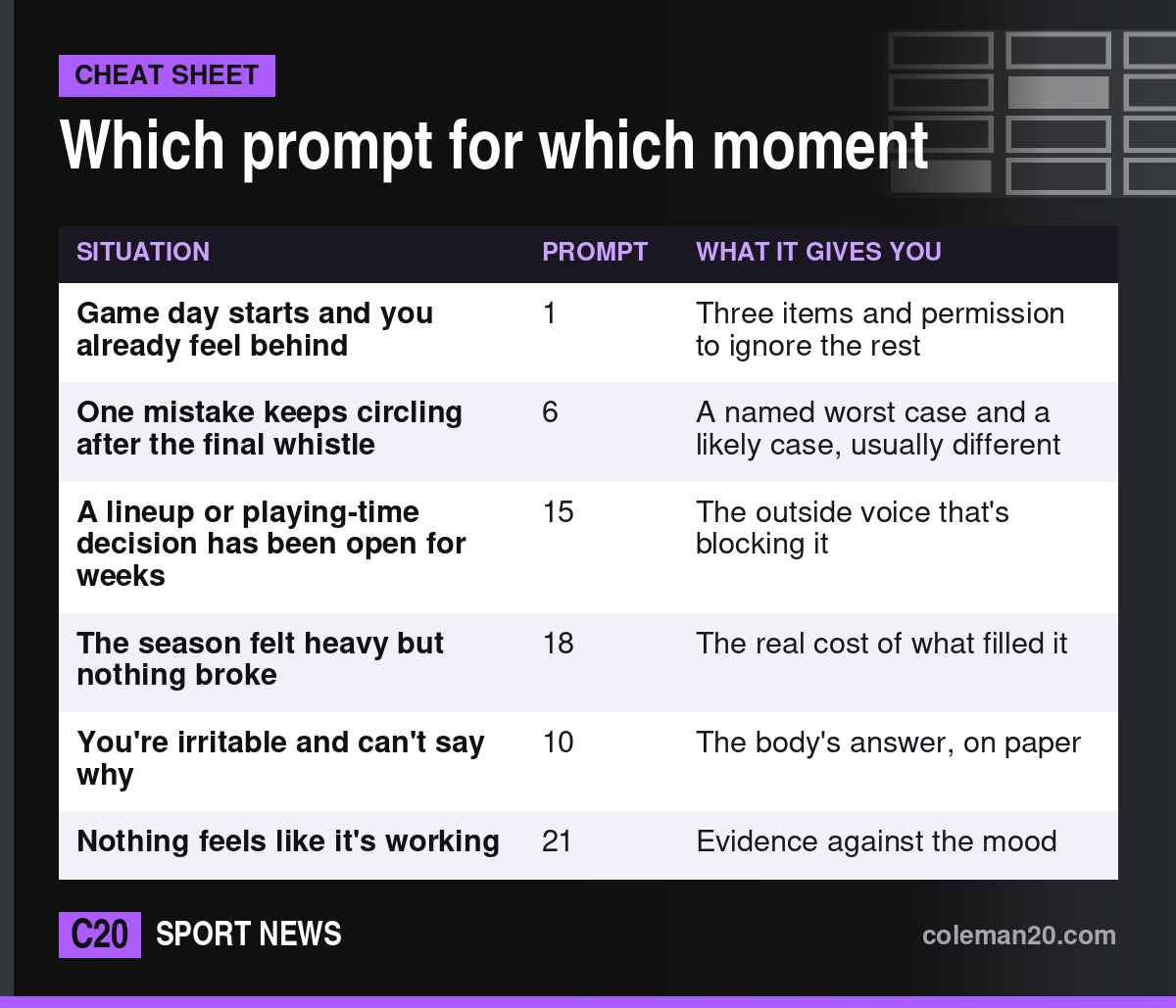
Which prompt for which moment
| Situation | Prompt | What it gives you |
|---|---|---|
| Game day starts and you already feel behind | 1 | Three items and permission to ignore the rest |
| One mistake keeps circling after the final whistle | 6 | A named worst case and a likely case, usually different |
| A lineup or playing-time decision has been open for weeks | 15 | The outside voice that's blocking it |
| The season felt heavy but nothing broke | 18 | The real cost of what filled it |
| You're irritable and can't say why | 10 | The body's answer, on paper |
| Nothing feels like it's working | 21 | Evidence against the mood |
How to make the habit stick
Same trigger every day: after practice, or right when you get home from the game. Keep the notebook in the gym bag. A prompt you can't see doesn't exist.
Stop when the timer rings, even mid-sentence. Restarting tomorrow from a half-finished sentence is easier than starting from a blank page.
Old pages are data. After a month you'll see which worries repeated and which never came true. That pattern is more honest than memory.
On Sunday, reread the week's pages for ten minutes, then look ahead. Our month-by-month guide to the sports calendar tells you what's on next week and when the schedule lets up.
Frequently asked questions
How does journaling help mental health?
Expressive-writing research since the 1980s links short sessions about real problems to lower reported stress and better mood. Naming a feeling in full sentences makes it concrete. A concrete problem can be acted on.
What should I write in my journal every day?
One prompt and an honest answer. Three lines you keep up beat three pages you abandon. If nothing comes, answer the simplest one: "What's on my mind right now?"
How long should I journal each day?
Five minutes is enough for a habit. The best-known studies used 15 to 20 minute sessions over several days, but for a practice you keep for years, five minutes daily beats thirty minutes you quit by February.
Is journaling a substitute for therapy?
No. Journaling organises thoughts. It doesn't treat illness. If low mood or anxiety lasts more than two weeks and affects sleep, training or work, speak to a doctor or licensed therapist.
Sources
Keep reading




Editors' picks
- What Sport Season Is It Right Now? A Month-by-Month Guide to US SportsSports Facts
- The Hardest Sports in the World, Ranked by What They DemandSports Facts
- What Is the Most Watched Sport in the World? Global and US RankingsSports Facts
- 30 Cool Baseball Facts Most Fans Don't KnowBaseball
- The Most Famous Sporting Events in the WorldSports Facts