Paper Soccer: Rules, Strategy and How to Play the Pen-and-Paper Game
All you need is graph paper and a pen. Here are the rules of paper soccer, the classic two-player strategy game, with tips to beat your friends and a look at its paper football cousin.

In this article
Paper soccer is a simple two-player strategy game played with a pen and a sheet of graph paper. Players take turns moving an imaginary ball across a grid, trying to reach the opponent's goal. It is especially popular in Poland and other parts of Europe, where generations of students have played it in the back of notebooks. It is also available as a free app and online game.
What you need
- A sheet of squared (graph) paper
- One pen (or two different colors, so each player's moves are easy to see)
- Two players
How to draw the field
- Draw a rectangle 8 squares wide and 10 squares long, following the grid lines.
- In the middle of each short side, draw a small goal 2 squares wide and 1 square deep, sticking out of the field.
- Mark the center point of the field with a dot. This is where the ball starts.
Players often agree on other field sizes, but 8 by 10 is the most common.
Basic rules
Moving the ball
On each turn, a player moves the ball from its current point to one of the eight neighboring points: up, down, left, right or diagonally. Draw a line to show the move. Players alternate, each defending one goal and attacking the other.
Lines cannot be reused
The ball cannot travel along a line that has already been drawn, and it cannot move along the edges of the field. The field's border acts like walls.
Bounces
This is the rule that makes paper soccer interesting. If the ball arrives at a point that has already been visited, or at a point on the edge of the field, it "bounces" and the same player moves again. A single turn can therefore include a long chain of moves.
Scoring
A player wins by moving the ball into the opponent's goal. Some players play a single game; others keep score over several rounds.
Getting stuck
If the ball reaches a point with no legal moves left, the player who moved it there loses (some versions say the player who cannot move loses). Agree on the rule before you start.
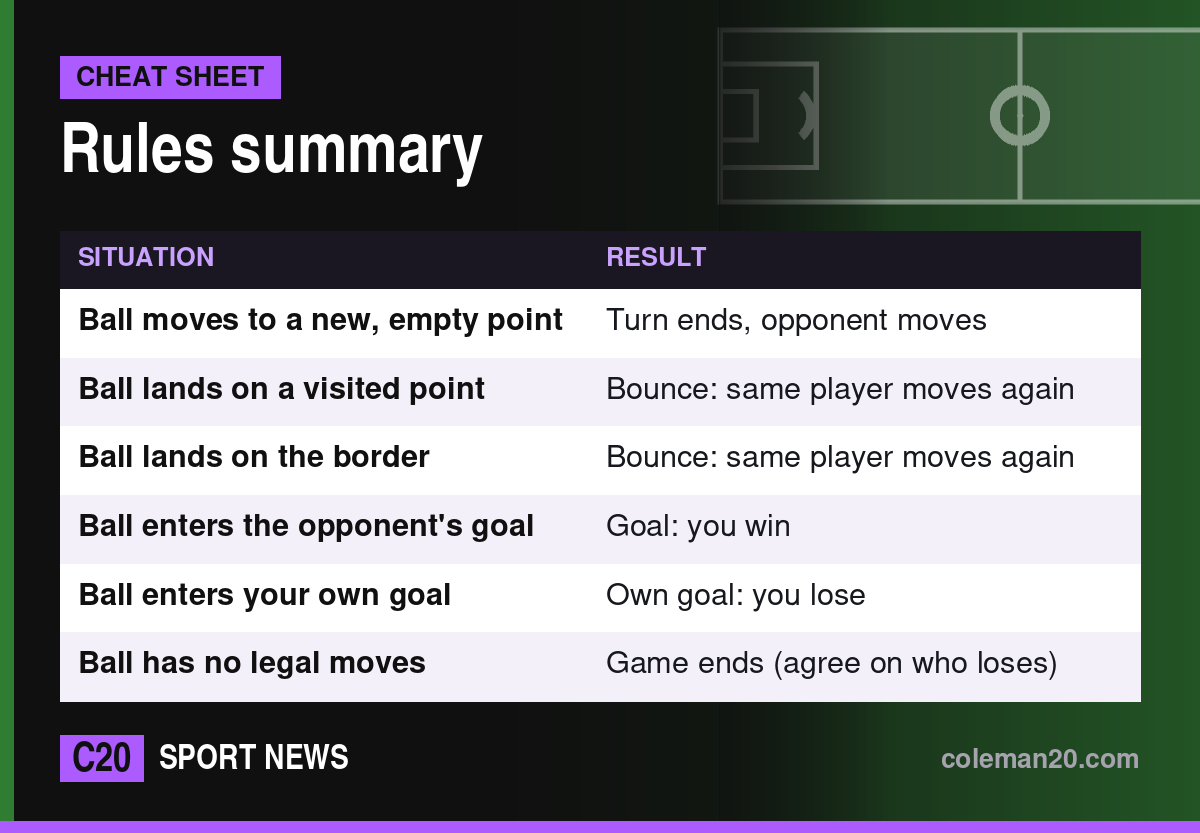
Rules summary
| Situation | Result |
|---|---|
| Ball moves to a new, empty point | Turn ends, opponent moves |
| Ball lands on a visited point | Bounce: same player moves again |
| Ball lands on the border | Bounce: same player moves again |
| Ball enters the opponent's goal | Goal: you win |
| Ball enters your own goal | Own goal: you lose |
| Ball has no legal moves | Game ends (agree on who loses) |
Strategy tips
- Plan your bounces – the best players chain several bounces in one turn, moving the ball a long way toward goal.
- Avoid giving away bounces – before ending your turn, check whether your opponent can start a long chain from your ending point.
- Use the walls – the border gives bounces, but the ball cannot move along it, which can trap play near the edge.
- Protect your goal area – lines drawn near your own goal can create dangerous bounce chains for your opponent. Keep the area clean.
- Think about traps – try to leave your opponent in a corner with few moves, ideally where every move gives you a bounce.
- Play the middle early – controlling the center keeps more options open.
Paper soccer vs paper football
Paper soccer is sometimes confused with paper football, a different tabletop game popular in American schools. In paper football, players fold a sheet of paper into a small triangle and flick it across a table. If the triangle stops with part of it hanging over the opponent's edge, it is a touchdown. After a touchdown, the player attempts a field goal by flicking the triangle through "goalposts" made by the opponent's fingers and thumbs.
| Paper soccer | Paper football | |
|---|---|---|
| Equipment | Graph paper and a pen | Folded paper triangle and a table |
| Skill | Strategy and planning | Flicking accuracy |
| Popular in | Poland and Europe | US schools |
| Scoring | Reach the opponent's goal | Touchdowns and field goals |
Why it is a great game for kids
Paper soccer is free, quiet and portable, which makes it perfect for road trips, rainy days and classrooms. It teaches planning several moves ahead, spatial thinking and patience. Many teachers use it as an introduction to strategy games, and it can be a fun way to get kids talking about real soccer tactics.
Playing online
Several apps and websites let you play paper soccer against friends or the computer. Online versions handle the rules automatically, which makes it easy to learn bounces and illegal moves. Some apps offer rankings and tournaments for experienced players.
Love soccer off the field too? Check out marathon soccer records and our guide to the striker's role.
Frequently asked questions
How do you play paper soccer?
Players take turns moving the ball one point at a time along a grid. Landing on a visited point or the border gives an extra move. The first to reach the opponent's goal wins.
How big is a paper soccer field?
The most common field is 8 by 10 squares, with goals 2 squares wide on each short side.
What is a bounce in paper soccer?
When the ball lands on a point that was already visited or on the field's border, the same player moves again.
Is paper soccer the same as paper football?
No. Paper soccer is a pen-and-paper strategy game; paper football uses a folded paper triangle flicked across a table.
Keep reading


Editors' picks
- What Sport Season Is It Right Now? A Month-by-Month Guide to US SportsSports Facts
- The Hardest Sports in the World, Ranked by What They DemandSports Facts
- What Is the Most Watched Sport in the World? Global and US RankingsSports Facts
- 30 Cool Baseball Facts Most Fans Don't KnowBaseball
- The Most Famous Sporting Events in the WorldSports Facts