Volleyball Rules Explained: Scoring, Rotation, Touches and Faults
Volleyball looks simple until the referee whistles a fault you did not see. Here are the indoor rules that decide almost every rally.

In this article
Volleyball is easy to start: hit the ball over the net and do not let it hit the floor on your side. The official rules add a few details that decide close rallies, from how many times a team may touch the ball to where a back-row player may jump from. This guide covers indoor volleyball as played under international rules, with notes where U.S. college and high school rules differ.
The basics
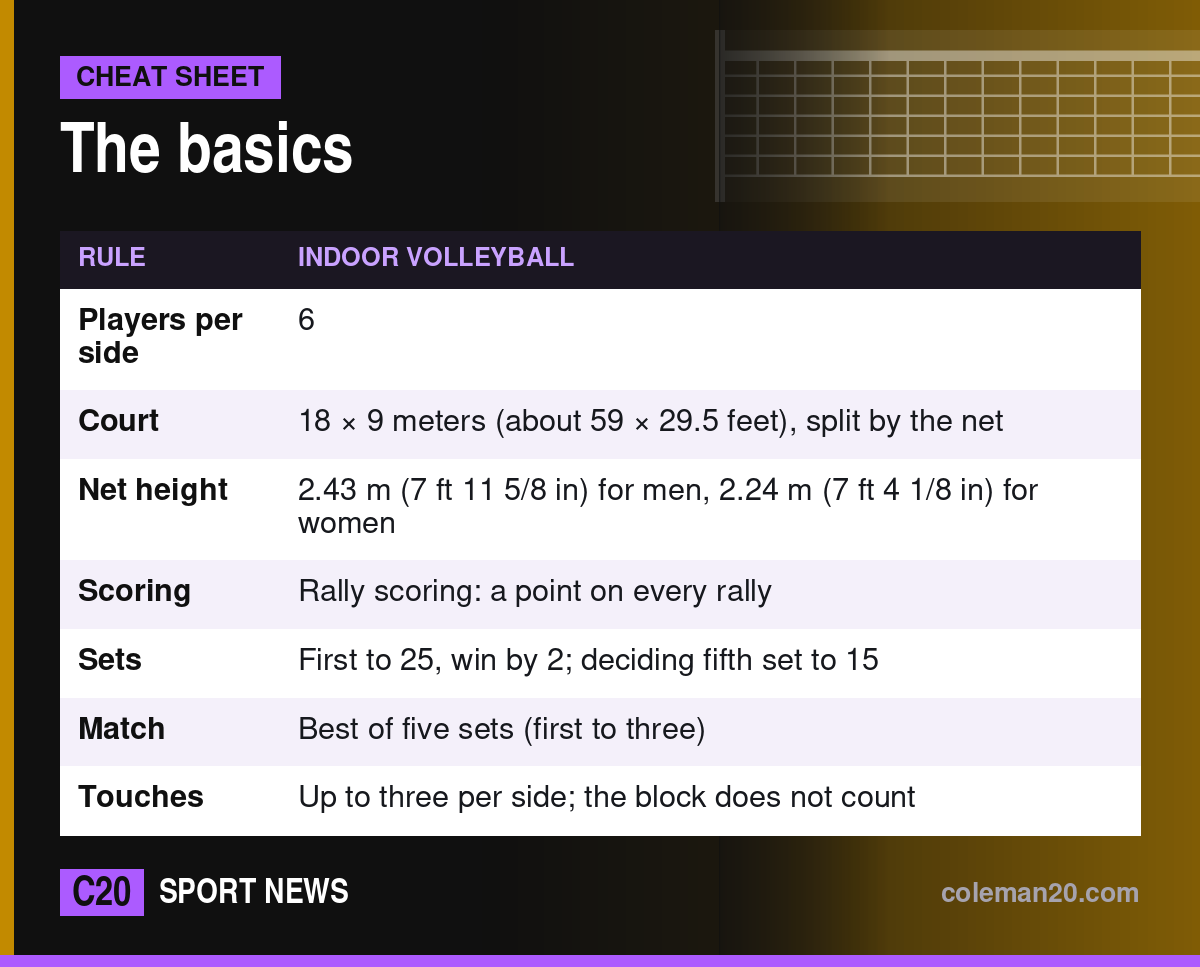
| Rule | Indoor volleyball |
|---|---|
| Players per side | 6 |
| Court | 18 × 9 meters (about 59 × 29.5 feet), split by the net |
| Net height | 2.43 m (7 ft 11 5/8 in) for men, 2.24 m (7 ft 4 1/8 in) for women |
| Scoring | Rally scoring: a point on every rally |
| Sets | First to 25, win by 2; deciding fifth set to 15 |
| Match | Best of five sets (first to three) |
| Touches | Up to three per side; the block does not count |
Scoring
Volleyball uses rally scoring: every rally ends with a point for one team, no matter who served. Sets are played to 25 points, and a team must win by two, so a set can finish 26-24, 27-25 or later. If the match reaches a fifth set, it is played to 15, again with a two-point margin.
Rally scoring arrived in international volleyball in 1999. Before that, only the serving team could score, which made matches much longer and harder to schedule for television.
Serving
The player in the right back position serves from behind the end line. The server has eight seconds after the referee's whistle to contact the ball and may serve underhand, overhand or with a jump serve. The serve may touch the net and still be good, as long as it goes over into the opponent's court. If a team wins a rally on the opponent's serve, it rotates one position clockwise and the next player serves.
Three touches
Each team may touch the ball up to three times before sending it over the net, typically a pass, a set and an attack. A player may not touch the ball twice in a row, with two exceptions:
- Blocking. A touch by blockers at the net does not count as one of the three, and a blocker may play the ball again right after the block.
- The first contact. When receiving a serve or a hard attack, a player may make consecutive contacts with the ball as long as it happens in a single action.
The ball must be hit cleanly, not caught or thrown. Referees call a "lift" or "catch" when the ball comes to rest in a player's hands, and a "double contact" when a set touches one hand and then the other.
Rotation and the attack line
At the moment of the serve, both teams must be in their correct rotation order. After the serve, players can move anywhere. The attack line, three meters from the net, creates one lasting difference between the front and back row: back-row players may not block, and they may not attack a ball that is completely above the net from in front of the attack line. They can still hit hard if they jump from behind the line, which is called a back-row attack.
Our guide to volleyball positions explains how teams use rotation to put their best hitters and blockers in the right places.
Common faults
- Ball out: the ball lands outside the court lines, touches the antenna or crosses the net outside the antennas. A ball that touches any part of the line is in.
- Four hits: a team touches the ball more than three times.
- Net fault: a player touches the net between the antennas while playing the ball.
- Center line fault: a player's foot crosses completely into the opponent's court. Part of the foot may be over the line as long as part stays on or above it.
- Reaching over: attacking a ball that is still on the opponent's side. Blockers may reach over, but not before the other team has made its attack.
- Attacking the serve: hitting or blocking the opponent's serve while the ball is in the front zone and completely above the net is a fault.
- Foot fault: the server steps on or over the end line before contacting the ball.
The libero
Each team may name a libero, a defensive specialist in a contrasting jersey. The libero plays only in the back row, may not attack the ball above net height and may not block. Under international rules the libero cannot serve; NCAA and high school rules allow the libero to serve in one rotation.
Timeouts and substitutions
Under international rules, each team has two 30-second timeouts per set and six substitutions per set. U.S. college volleyball allows more: NCAA women's teams get 15 substitutions per set. Libero replacements do not count as substitutions.
How U.S. rules differ
NCAA and high school volleyball follow the same basic game, with differences in details such as the number of substitutions, the libero's serving rights and challenge systems. Club tournaments may shorten matches to two sets to 25 with a third set to 15, so many teams can play in one day; event software such as Advanced Event Systems lists the format of each tournament.
Beach volleyball has its own rules: two players per side, a smaller court and sets to 21. See our guide to beach volleyball vs. indoor volleyball for the differences.
Frequently asked questions
How many points is a volleyball set?
Indoor sets are played to 25 points, and a team must win by two. A deciding fifth set is played to 15.
Can you hit the ball twice in volleyball?
Not in a row, except after blocking or during the first contact of a rally when receiving a hard-driven ball in a single action.
Is the ball in if it hits the line?
Yes. The lines are part of the court, so a ball that touches any part of the line is in.
Can the serve hit the net?
Yes. Under current international, college and high school rules, a serve that touches the net and goes over into the opponent's court is in play.
Keep reading


Editors' picks
- What Sport Season Is It Right Now? A Month-by-Month Guide to US SportsSports Facts
- The Hardest Sports in the World, Ranked by What They DemandSports Facts
- What Is the Most Watched Sport in the World? Global and US RankingsSports Facts
- 30 Cool Baseball Facts Most Fans Don't KnowBaseball
- The Most Famous Sporting Events in the WorldSports Facts