Football Positions Explained: Offense, Defense and Special Teams
Twenty-two players are on the field at every snap. Here is what each football position does on offense, on defense and on special teams, and how teams line up.

In this article
An American football team has 11 players on the field at a time, and three separate units: offense, defense and special teams. Each position has a specific job, and many players spend their whole careers in one role. Here is how they fit together.
Offense: the 11 positions
An offense must have at least seven players on the line of scrimmage. A typical formation looks like this:
| Position | How many (typical) | Job |
|---|---|---|
| Quarterback (QB) | 1 | Takes the snap, passes, hands off, sometimes runs |
| Running back (RB/HB) | 1 | Runs with the ball, catches short passes, blocks |
| Fullback (FB) | 0–1 | Lead blocker for the running back |
| Wide receiver (WR) | 2–4 | Runs routes and catches passes |
| Tight end (TE) | 1–2 | Blocks like a lineman and catches like a receiver |
| Center (C) | 1 | Snaps the ball, calls blocking assignments |
| Guards (G) | 2 | Block beside the center |
| Tackles (T) | 2 | Block on the outside of the line; the left tackle often protects a right-handed QB's blind side |
The five interior linemen (center, two guards, two tackles) cannot catch forward passes in normal circumstances. With the quarterback and five "skill" players (backs, receivers, tight ends), that makes 11.
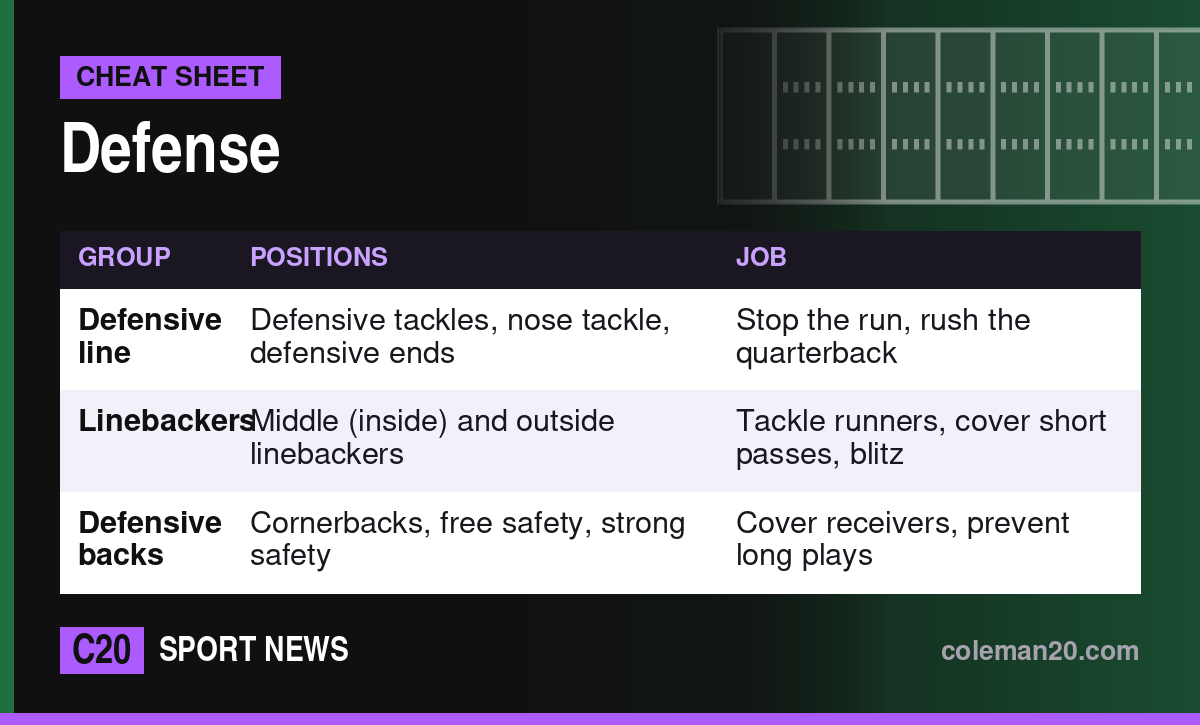
Defense
| Group | Positions | Job |
|---|---|---|
| Defensive line | Defensive tackles, nose tackle, defensive ends | Stop the run, rush the quarterback |
| Linebackers | Middle (inside) and outside linebackers | Tackle runners, cover short passes, blitz |
| Defensive backs | Cornerbacks, free safety, strong safety | Cover receivers, prevent long plays |
Defenses are named by their front: a 4-3 has four linemen and three linebackers, a 3-4 three linemen and four linebackers. Against passing offenses, teams use a nickel defense with five defensive backs or a dime with six.
Special teams
- Kicker (K): kickoffs, field goals and extra points.
- Punter (P): kicks the ball away on fourth down.
- Long snapper (LS): snaps for punts and kicks.
- Holder (H): holds the ball for field goals, often the punter.
- Kick and punt returners (KR/PR): run back kicks.
- Gunners and coverage players: race downfield to tackle the returner.
Which position is hardest?
Quarterback is widely seen as the most demanding: reading the defense, calling protections and throwing accurately under pressure. Left tackle and cornerback are also notoriously difficult, and teams pay them accordingly.
Positions in youth football
Youth teams often play fewer players a side, and coaches rotate young players through several positions. Flag football leagues remove tackling and linemen blocking entirely, putting the emphasis on passing and running.
Frequently asked questions
What are the 11 positions in football?
On offense, typically a quarterback, five offensive linemen (center, two guards, two tackles) and five skill players such as running backs, wide receivers and tight ends.
What are the defensive positions in football?
Defensive linemen (tackles and ends), linebackers (inside and outside) and defensive backs (cornerbacks and safeties).
What is the difference between a 4-3 and a 3-4 defense?
A 4-3 uses four linemen and three linebackers; a 3-4 uses three linemen and four linebackers.
Sources
Keep reading


Editors' picks
- What Sport Season Is It Right Now? A Month-by-Month Guide to US SportsSports Facts
- The Hardest Sports in the World, Ranked by What They DemandSports Facts
- What Is the Most Watched Sport in the World? Global and US RankingsSports Facts
- 30 Cool Baseball Facts Most Fans Don't KnowBaseball
- The Most Famous Sporting Events in the WorldSports Facts