The Soccer Pyramid Explained: US vs England, Promotion and Relegation
Soccer leagues are organized as a pyramid: a single top league and many levels below it. Here is how the US system works, how it differs from England's and why promotion and relegation matter.

In this article
In most countries, soccer leagues are organized as a pyramid. A single top division sits at the peak, with more leagues and more teams at each level below it, all the way down to local amateur clubs. In much of the world, teams can move up and down this pyramid each season based on results. The United States has a pyramid too, but it works very differently.
What the soccer pyramid means
A league pyramid is a ranking of competitions by level. Level one is the top professional league. Level two is the next best, and so on. The pyramid shape comes from the fact that there are more leagues and teams the lower you go. In countries with promotion and relegation, the pyramid is "open": the best teams in a league move up to the next level, and the worst teams drop down.
The English football pyramid
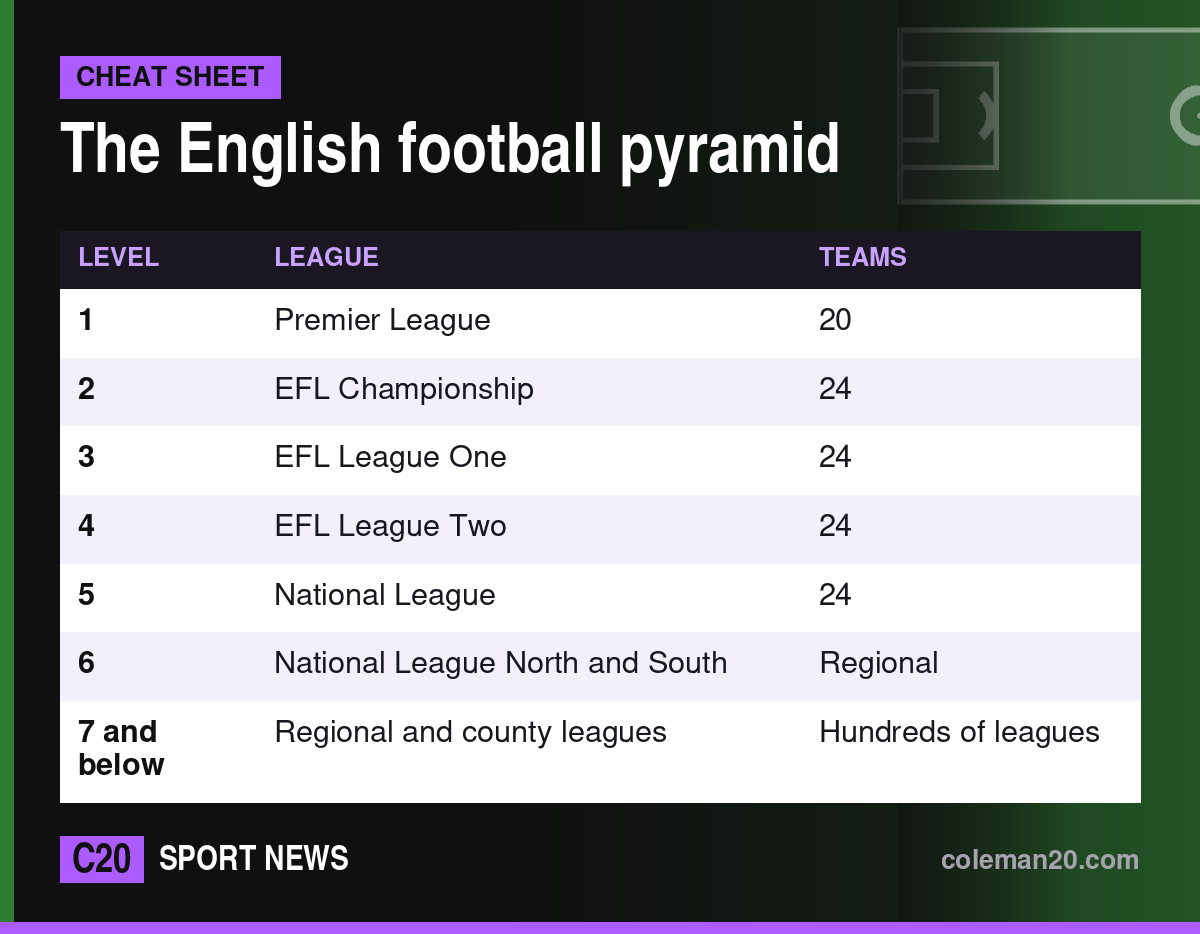
England's system is the classic example. It contains hundreds of leagues and thousands of clubs, all connected through promotion and relegation.
| Level | League | Teams |
|---|---|---|
| 1 | Premier League | 20 |
| 2 | EFL Championship | 24 |
| 3 | EFL League One | 24 |
| 4 | EFL League Two | 24 |
| 5 | National League | 24 |
| 6 | National League North and South | Regional |
| 7 and below | Regional and county leagues | Hundreds of leagues |
Each season, the bottom three Premier League clubs are relegated to the Championship, and three teams come up: two automatically and one through a playoff. The Championship playoff final at Wembley is often called the richest game in soccer because of the TV money that comes with promotion. In theory, a small amateur club could climb all the way to the Premier League, and a few have climbed remarkably far.
The US soccer pyramid
In the US, the governing body, U.S. Soccer, sanctions professional leagues as Division I, II or III based on standards such as stadium size, number of teams, ownership finances and market size.
| Level | Men's leagues | Notes |
|---|---|---|
| Division I | Major League Soccer (MLS) | Top league, includes teams from Canada |
| Division II | USL Championship | Professional teams across the country |
| Division III | USL League One | Smaller professional markets |
| Development | MLS Next Pro | Mostly MLS reserve teams, plus independent clubs |
| Amateur / pre-professional | USL League Two, NPSL and others | Many college players play here in summer |
On the women's side, the National Women's Soccer League (NWSL) is the top professional league, and the USL Super League, launched in 2024, also received Division I status. Amateur leagues such as the USL W League and WPSL sit below them.
Promotion and relegation: the big difference
MLS uses a closed system. Teams join through expansion, paying a large fee for a place in the league, and they cannot be relegated no matter how badly they finish. The same is true for the NFL, NBA, MLB and NHL. Lower-division US teams cannot earn promotion to MLS either.
Supporters of promotion and relegation argue it makes every game meaningful, gives ambitious lower-league clubs a path to the top and keeps fans engaged even at the bottom of the table. Opponents argue that relegation would make investing in American soccer too risky for owners, especially when teams build expensive stadiums. The USL has announced plans to introduce promotion and relegation between its own leagues, a step that would bring a version of the open pyramid to American soccer.
How the US Open Cup connects the pyramid
Even without promotion, there is one competition where every level meets: the Lamar Hunt U.S. Open Cup. Founded in 1914, it is one of the oldest national soccer competitions in the world. Amateur and lower-division teams can face MLS sides, and giant-killing upsets happen regularly, much like England's FA Cup.
Comparing the two systems
| Feature | England | United States |
|---|---|---|
| Promotion and relegation | Yes, throughout the pyramid | No in MLS; planned within USL |
| How clubs join the top level | Earn promotion | Expansion fee |
| Playoffs to decide the champion | No, the league table decides | Yes, MLS Cup playoffs |
| Season calendar | August to May | February to December |
| National cup | FA Cup | U.S. Open Cup |
The youth development pyramid
"Soccer pyramid" can also describe player development. A wide base of recreational youth players narrows into club teams, elite academies, college soccer and finally professional teams. MLS clubs run academies to develop young players, and the best can sign "homegrown" contracts with their first teams. Coaches often say that a broad base of players who enjoy the game is what produces stars at the top.
For more on how soccer compares with other sports, read is soccer the best sport in the world.
Frequently asked questions
What is the soccer pyramid?
The ranking of leagues in a country by level, from the top professional league down to local amateur leagues.
Does MLS have relegation?
No. MLS is a closed league: teams join through expansion and cannot be relegated.
What is Division 2 soccer in the US?
The USL Championship is the men's Division II professional league.
How many teams are relegated from the Premier League?
Three teams are relegated to the Championship each season, and three are promoted.
Keep reading




Editors' picks
- What Sport Season Is It Right Now? A Month-by-Month Guide to US SportsSports Facts
- The Hardest Sports in the World, Ranked by What They DemandSports Facts
- What Is the Most Watched Sport in the World? Global and US RankingsSports Facts
- 30 Cool Baseball Facts Most Fans Don't KnowBaseball
- The Most Famous Sporting Events in the WorldSports Facts