The Rules of Soccer: A Beginner’s Guide to the Laws of the Game
Soccer has 17 official laws, but you only need a few to follow a match. The basics of players, time, restarts, offside, fouls and cards, explained for new fans.

In this article
Soccer's rules are officially called the Laws of the Game. There are 17 of them, maintained by the International Football Association Board (IFAB) and used, with small adaptations, from youth leagues to the World Cup. Here are the essentials for following and playing a match.
The basics
- Two teams of 11 players, including one goalkeeper each. A team needs at least seven players to start or continue a match.
- The aim: get the whole ball over the opponent's goal line between the posts and under the crossbar.
- Hands: only the goalkeeper may handle the ball, and only inside his or her own penalty area.
- Length: two halves of 45 minutes, plus stoppage time added by the referee. Youth matches are shorter.
- Knockout matches may go to 30 minutes of extra time and then a penalty shootout.
Restarts
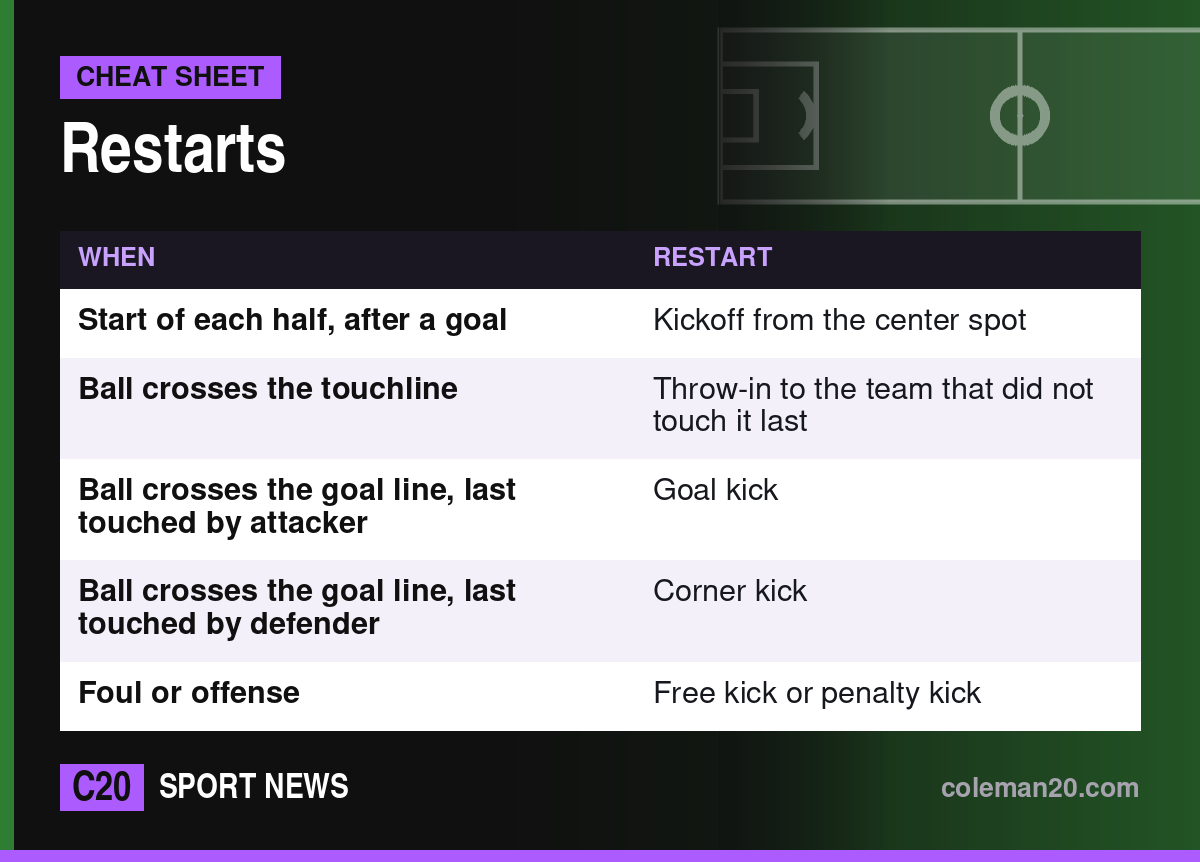
| When | Restart |
|---|---|
| Start of each half, after a goal | Kickoff from the center spot |
| Ball crosses the touchline | Throw-in to the team that did not touch it last |
| Ball crosses the goal line, last touched by attacker | Goal kick |
| Ball crosses the goal line, last touched by defender | Corner kick |
| Foul or offense | Free kick or penalty kick |
Offside
A player is in an offside position if, when a teammate plays the ball, he or she is in the opponent's half and closer to the opponent's goal line than both the ball and the second-to-last defender (usually the last outfield defender, with the goalkeeper as the last). Being in an offside position is only punished if the player becomes involved in play. There is no offside from a goal kick, throw-in or corner kick.
Offside has been part of the game since the first Football Association rules of 1863; the modern "two defenders" version dates from 1925.
Fouls, free kicks and penalties
- Direct free kick: for fouls such as tripping, pushing, holding, kicking an opponent or deliberate handball. A goal can be scored directly.
- Indirect free kick: for offenses such as offside or dangerous play; another player must touch the ball before a goal counts.
- Penalty kick: a direct-free-kick offense by a defender inside his or her own penalty area, taken from 12 yards (11 m).
Yellow and red cards
- Yellow card (caution): for unsporting behavior, persistent fouling, dissent or delaying the restart.
- Red card (sending off): for serious foul play, violent conduct, denying an obvious goal-scoring opportunity in many cases, or a second yellow. The team plays with one fewer player.
Substitutions
Most top competitions allow five substitutions per team, made in no more than three stoppages plus half-time. Youth and amateur leagues often allow rolling substitutions.
Video assistant referee (VAR)
In many professional competitions, video officials can recommend a review of clear and obvious errors in four situations: goals, penalty decisions, direct red cards and mistaken identity.
Learn more about the game: what a striker does and how the soccer pyramid works.
Frequently asked questions
What are the basic rules of soccer?
Two teams of 11 try to put the ball in the opponent’s goal without using their hands (except the goalkeeper), over two 45-minute halves, following rules on offside, fouls and restarts.
How many rules are in soccer?
There are 17 Laws of the Game, maintained by the IFAB.
What is the offside rule?
An attacker is offside if, when a teammate plays the ball, he or she is in the opponent’s half and nearer the goal line than both the ball and the second-to-last defender, and becomes involved in play.
When was the offside rule introduced?
Offside was in the first Football Association rules of 1863; the current two-defender version dates from 1925.
Sources
Keep reading




Editors' picks
- What Sport Season Is It Right Now? A Month-by-Month Guide to US SportsSports Facts
- The Hardest Sports in the World, Ranked by What They DemandSports Facts
- What Is the Most Watched Sport in the World? Global and US RankingsSports Facts
- 30 Cool Baseball Facts Most Fans Don't KnowBaseball
- The Most Famous Sporting Events in the WorldSports Facts